Mesothelioma: Staging and Treatment
What is staging for cancer?
Staging is the process of learning how much cancer is in your body and where it is. You may have imaging tests, blood tests, and/or surgery to stage mesothelioma.
- Clinical stage: This helps choose your treatment plan. You may have an X-ray, CT scan, echocardiogram, PET scan, MRI, biopsy, and blood tests. Blood tests may check Fibulin-3 and soluble mesothelin-related peptides (SMRP’s).
- Surgical stage: If you need surgery, your provider can use your clinical stage plus what they see during the operation to give a more accurate stage (sometimes called the pathological stage).
Staging looks at the size of the tumor, where it is, and if it has spread to other organs. There are a few kinds of mesothelioma, depending on where it is in your body. Pleural (lung) mesothelioma is the most common. There is also peritoneal (belly), pericardial (heart), and testicular mesothelioma. Often, only pleural mesothelioma is staged using the system below. Your provider will talk with you about your type of mesothelioma and whether a staging system will be used.
A staging system called the “TNM” system,” as described by the American Joint Committee on Cancer, helps to guide the staging of mesothelioma. It has three parts:
- T- Describes the size/location/extent of the "primary" tumor in the lung.
- N- Describes if the cancer has spread to the lymph nodes.
- M- Describes if the cancer has spread to other organs (metastases).
How is mesothelioma staged?
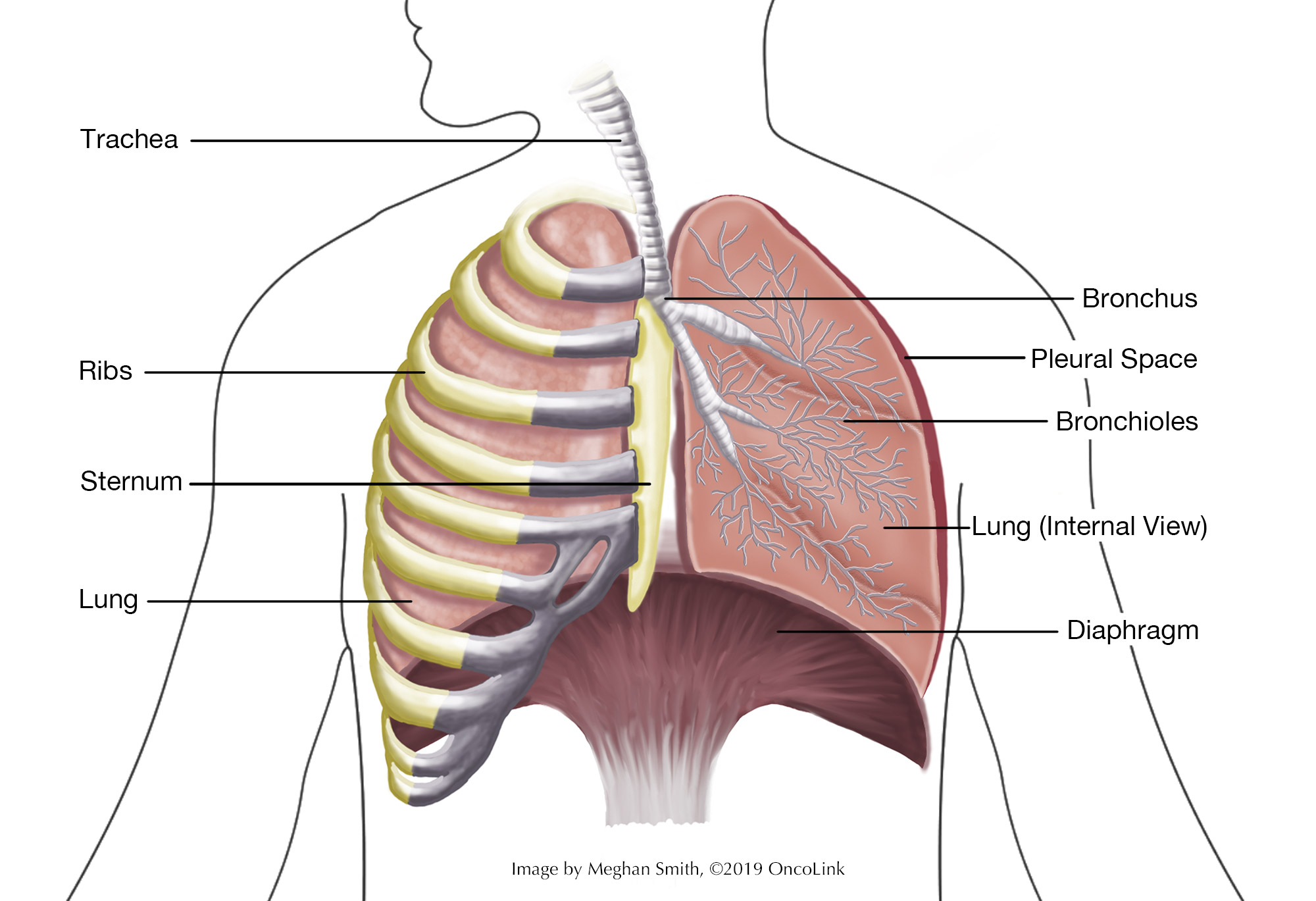
Anatomy of the chest.
Your provider will use the results of the tests you had to figure out your TNM result and combine these to get a stage from I (one) to IV (four). The staging system for pleural mesothelioma is very complex. Below is a summary. Talk to your provider about the stage of your cancer.
Stage I (T1, N0, M0): The cancer is on one side of the chest in the pleura lining. It may also be in the diaphragm (the muscle between the lungs), the mediastinum (space between the lungs), or covering the pleura lining of the lung (T1). The cancer is not in any of the lymph nodes (N0), or any other body parts (M0).
Stage II (T2, N0, M0): The cancer is on one side of the chest in the pleura lining. It is also in the pleura lining the diaphragm, mediastinum, and the lung. The cancer is also inside the diaphragm or the lung (T2). The cancer is not in any of the lymph nodes (N0), or any other body parts (M0); OR (T1, N1, M0): The cancer is on one side of the chest in the pleura lining (T1). Mesothelioma is in nearby lymph nodes on the same side as the other tumor (N1). The cancer is not in any other body parts (M0).
Stage IIIA (T2 or T3, N1 or N0-N1, M0): The cancer is on one side of the chest in the pleura lining. It is also in the pleura lining the diaphragm, mediastinum, and the lung. The cancer is also inside the diaphragm or the lung (T2), or the cancer has grown to nearby areas and may be able to be taken out with surgery (T3). The cancer is not in any of the lymph nodes (N0), or the cancer is in nearby lymph nodes on the same side as the tumor (N1). The cancer is not in any other body parts (M0); OR (T1-T3, N2, M0): The cancer may or may not be in the nearby areas and may be able to be taken out with surgery (T1 to T3). The cancer has spread to the lymph nodes on the other side of the body or the lymph nodes near the collarbone on either side (N2). The cancer is not in any other body parts (M0)
Stage IIIB (T4, Any N, M0) The cancer has grown too much and cannot be taken out with surgery (T4). The cancer has grown into at least one of these:
- More than one area in the deeper chest wall layers, such as muscle or ribs.
- Through the diaphragm and peritoneum (belly lining).
- Any of the mediastinum organs (heart, spine, esophagus, thymus, trachea, blood vessels).
- In the pleura on the other side of the chest.
- Pericardium lining or inside the heart.
The cancer may or may not be in the nearby lymph nodes (any N). The cancer is not in any other body parts (M0).
Stage IV (Any T, any N, M1): The cancer may or may not be in nearby organs (any T). The cancer may or may not have spread to the lymph nodes (any N). The mesothelioma has spread to organs, bones, the liver, the lung, the pleura on the other side of the body, or the peritoneum.
How is mesothelioma treated?
Treatment for mesothelioma is based on the stage. Your treatment may include some or all of these:
- Surgery.
- Radiation.
- Chemotherapy.
- Immunotherapy
- Targeted Therapy
- Tumor Treating Fields Therapy.
- Palliative treatment.
- Clinical trials.
Surgery
Surgery may be an option for some patients. Surgery to either remove the entire lung with the tumor (called extrapleural pneumonectomy) or lung-sparing surgery that removes only the tumor and the lining of the lung (which is called extended or radical pleurectomy), is the most common when surgery is an option.
Radiation
Radiation is the use of high-energy X-rays to kill cancer cells. Radiation therapy is often done after surgery to remove the entire lung to kill any remaining cancer cells. Radiation therapy after lung-sparing surgery is not routinely given. The radiation can damage the healthy lung tissue and result in side effects that outweigh any benefit of radiation. Radiation therapy is often delivered to surgical incision sites to prevent the cancer from recurring (coming back) in that area. In patients who do not undergo surgery, radiation therapy may be given to treat problem areas to relieve symptoms (called palliative radiation), like pain or trouble breathing.
Chemotherapy
Chemotherapy is the use of medications to kill cancer cells and is a common treatment for mesothelioma. Medications that are used, either alone or in combination, include cisplatin, carboplatin, doxorubicin, pemetrexed, gemcitabine, nivolumab, ipilimumab, pembrolizumab, and vinorelbine.
Immunotherapy
Immunotherapy medications work with the immune system to kill cancer cells. Immunotherapy medications that may be used in the treatment of mesothelioma are pembrolizumab, nivolumab, and ipilimumab. Your provider will talk to you about these medications and what side effects you may have. Other immunotherapy medications are being studied in clinical trials.
Targeted Therapy
Some cancers have biomarkers that help providers focus your treatment on certain genetic mutations or receptors in your tumor. These treatments are called targeted therapies. They target those genetic mutations. Your provider will test your tumor for these markers. Anti-angiogenesis agents/VEGF inhibitors can be used in the treatment of mesothelioma. These can include bevacizumab, pemetrexed, cisplatin, and ramucirumab.
Your provider will talk to you about if targeted therapy can be used to treat your cancer and any side effects that you may have. Other targeted therapy medications are being studied in clinical trials.
Tumor Treating Fields (TTFields) Therapy
TTFields Therapy uses alternating electric fields to affect the ability of cancer cells to divide and multiply. TTFields is often used at the same time as chemotherapy for patients with mesothelioma that cannot be removed by surgery. A wearable medical device called Optune Lua™ is used and two special pads are placed on your chest to deliver low-intensity, alternating electric fields.
Palliative Treatment
Palliative therapy is used to relieve symptoms that are caused by the cancer. They do not cure the cancer. There are many options for palliative treatments, including chemotherapy, radiation, surgery, stent placement, laser therapies, and removal of extra fluid from around the heart, lungs, or abdomen (belly). Some of the palliative treatments for mesothelioma are having a pleural catheter put in, paracentesis, and thoracentesis. Talk to your provider about your options for managing your symptoms.
Clinical Trials
You may be offered a clinical trial as part of your treatment plan. To find out more about current clinical trials, visit the OncoLink Clinical Trials Matching Service.
Making Treatment Decisions
Your care team will make sure you are a part of choosing your treatment plan. This can be overwhelming as you may be given a few options to choose from. Take the time to meet with different providers and think about your options and what is best for you. This is a personal decision. Friends and family can help you talk through the options and the pros and cons of each, but they cannot make the decision for you. You need to be comfortable with your decision – this will help you move on to the next steps. If you ever have any questions or concerns, be sure to call your team.
You can learn more about mesothelioma at OncoLink.org.